Japan travel itinerary guide
Hi, this is Yusuke from Discover Japan Hidden.
If you are searching japan travel itinerary, you are probably trying to figure out how many days you should stay, how to connect Tokyo, Kyoto, and Osaka, and whether a 7-day Japan itinerary or a 10-day Japan itinerary makes more sense for your trip. Maybe you are comparing a self-guided Japan travel itinerary with group tours, or looking for first-time Japan itinerary tips that feel honest and realistic, not just Instagram-perfect highlights that leave you exhausted.
I live in Japan and often help overseas visitors build their own japan travel itinerary from zero, including Tokyo Kyoto Osaka itinerary ideas, day trips to places like Hakone and Nara, and practical questions like when the best time to visit Japan itinerary plan actually is, how to keep a budget Japan travel itinerary realistic, and when a JR Pass for a Japan travel itinerary is truly worth it. I know it can feel overwhelming when you see so many options: family-friendly plans, solo backpacking, short layovers, and three-week deep dives across the country.
In this guide, I want to walk with you step by step, like a local friend who has seen both the good and the stressful sides of travel planning. We will start by getting started with a Japan travel itinerary in a simple way, then look at 7-day Japan itinerary basics, 10-day Japan itinerary planning, and how to shape a practical guide to a Japan travel itinerary that matches your travel style instead of forcing you into a one-size-fits-all template. Along the way, I will also share self-guided Japan itinerary advice, ideas for a family Japan travel itinerary that does not burn out your kids, and a final Japan travel itinerary summary so you can adjust the plan comfortably.
By the end, my goal is that you can look at your calendar and say, “Okay, this is my japan travel itinerary, it fits my budget, it feels relaxed enough, and I actually understand how to move around.” I want you to feel that the plan is yours, not something copied blindly from a random blog. If that is the kind of trip you want, let’s start planning together in a way that feels calm and enjoyable for you.
- How to choose the right length and style of your Japan travel itinerary
- Concrete route ideas for 7–10 days around Tokyo, Kyoto, and Osaka
- Local tips on JR Pass, season, budget、and daily logistics
- How to adapt the itinerary for solo travelers, couples、and families
Japan travel itinerary planning basics
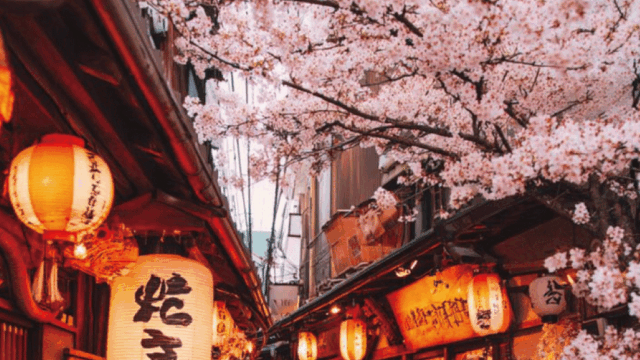
In this first part, I will help you understand the overall structure of a japan travel itinerary: how many days to stay, how to balance big cities and slower days, and what kind of route works well for first-time visitors. Think of this section as the “map” before we go into the details, so you can see the whole picture and then zoom into the day-by-day schedule without confusion.
Getting Started with a Japan Travel Itinerary and First-time Japan itinerary tips

When you start getting serious about a Japan trip, the first big question is usually very simple: where do you even begin? For a first-time visitor, there is so much information that it is easy to open ten tabs and then feel stuck. So let’s slow down and make your starting point clear.
For a first-time japan travel itinerary, the most stable foundation is to build around three pillars: time, theme, and energy. If these three are clear, almost every other decision becomes easier.
1. Time: total days and travel pace
Time is not just the number of nights. It is also how many full days you actually have on the ground. For example, if your flight arrives late at night and departs early in the morning, those are basically “half” days at best. A 7-night trip often feels like 6 full days or even 5.5 days when you include airport transfers. When planning your first-time Japan itinerary tips, always count how many full days you truly have to explore.
Once you know that, choose your travel pace:
- Slow pace: stay 4–5 nights in one city, use day trips, and leave gaps for wandering
- Medium pace: 3 nights in each main city, 2–3 city bases in total
- Fast pace: new city almost every day or two (honestly, I rarely recommend this for first-timers)
Most first-time travelers are happier with a medium pace, where they can still see a lot without feeling like they are permanently packing and unpacking suitcases.
2. Theme: what kind of trip you actually want
Next, think about the theme of your trip. If you come with friends who love anime, your japan travel itinerary will look very different from a honeymoon focused on hot springs and quiet dinners. Some common themes are:
- Food-focused: ramen, sushi, izakaya hopping, street food in Osaka
- Culture-focused: temples in Kyoto, castles, traditional neighborhoods
- Nature-focused: Fuji area, coastal views, hiking, onsen towns
- Pop culture-focused: Akihabara, theme parks, game centers, anime locations
You can of course mix themes, but it helps to choose one or two main ones so your schedule does not become totally random. If you try to “do everything,” you usually end up enjoying each thing less.
3. Energy: how much movement you enjoy
Energy is a very honest conversation with yourself and your travel partners. Do you enjoy waking up early every day, transferring trains with luggage, and arriving at a new hotel every night? Or do you prefer staying in one place for a few nights and really getting to know the neighborhood café and the nearest convenience store? There is no right answer, but being honest about this makes your first-time Japan itinerary tips truly useful.
For a first trip, I suggest limiting your hotel bases to two or three cities. From each base, use day trips to extend your reach without the stress of constant check-outs.
Point: Before you worry about tiny details like exact train numbers or restaurant bookings, first decide your total days, your main theme, and how many hotel bases you want. Once those are clear, every other decision in your japan travel itinerary becomes a gentle adjustment instead of a big headache.
7-day Japan itinerary basics for beginners

For a one-week trip, you need to be a bit strict with your choices, but it is still very possible to enjoy a lot without rushing. A common and reliable pattern for 7-day Japan itinerary basics is to focus on the “Golden Route” with minimal detours.
Recommended structure for 7 days
Here is a simple and realistic example of how a 7-day japan travel itinerary could look:
| Day | Base city | Suggested focus |
|---|---|---|
| Day 1 | Tokyo | Arrival, check-in, neighborhood walk |
| Day 2 | Tokyo | Asakusa, Tokyo Skytree, Sumida River area |
| Day 3 | Tokyo | Shibuya, Harajuku, Meiji Shrine, Shinjuku at night |
| Day 4 | Kyoto | Travel to Kyoto, Gion evening stroll |
| Day 5 | Kyoto | Fushimi Inari, Higashiyama, Kiyomizu-dera |
| Day 6 | Kyoto | Arashiyama bamboo, Tenryu-ji, river walk |
| Day 7 | Kyoto or Tokyo | Optional Nara half-day or return to airport city |
This pattern gives you three full days in Tokyo and three in Kyoto, with a flexible last day. You can fit in a short Nara visit or simply use the final day to shop and relax before your flight. For beginners, this kind of rhythm feels much kinder than changing cities every day.
What to avoid in a 7-day itinerary
In only one week, it is usually better to skip extremely distant regions like Hokkaido or Okinawa unless they are your absolute main goal. Even Hiroshima and Miyajima, while beautiful, can make the schedule too tight if you also want enough time in Tokyo and Kyoto. You do not want your 7-day Japan itinerary basics to turn into a long-distance transport challenge.
Another common mistake is trying to visit every famous Tokyo district in two days: Shibuya, Shinjuku, Harajuku, Akihabara, Odaiba, Ginza, Roppongi, and more. On the map it looks possible, but in real life it becomes a blur. Choose a few zones for each day and enjoy them more deeply.
Making the most of short stays
To get more enjoyment out of a short japan travel itinerary, you can:
- Stay near a major station (like Shinjuku, Shibuya, or Kyoto Station) to reduce travel time
- Pre-book at least key attractions that require reservations (such as certain museums or theme parks)
- Plan one “anchor experience” per day that you really care about, and let the rest be flexible
With this approach, a 7-day trip stops feeling “too short” and instead becomes a focused, memory-rich experience that gives you a great base for a future, longer visit.
10-day Japan itinerary planning step by step
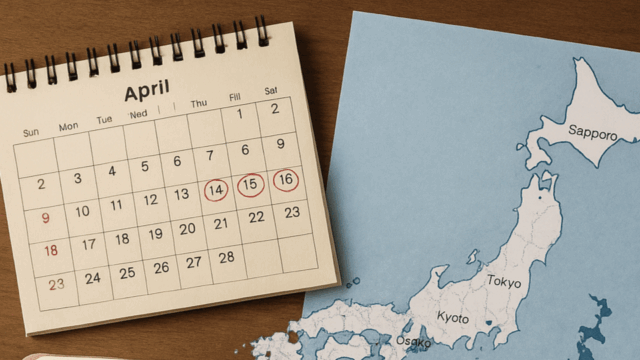
Once you have around ten days, your 10-day Japan itinerary planning becomes much more flexible and relaxed. You can still keep the same Tokyo–Kyoto core, but now you have the room to add an extra flavor: hot springs, a Fuji view, or a more off-the-beaten-path town.
Example of a 10-day structure
Here is a balanced 10-day japan travel itinerary that many first-time visitors enjoy:
- Days 1–3: Tokyo – Jet lag recovery, main city sights
- Days 4–5: Hakone or Kawaguchiko – Hot springs, nature, possible Fuji views
- Days 6–9: Kyoto – Temples, shrines, traditional streets, day trip options
- Day 10: Nara or Osaka and departure – Short final stop before the airport
Within Tokyo, you now have time for one slower day: maybe a neighborhood walk in Shimokitazawa or Kichijoji, or a quieter museum day. In Kyoto, four nights mean you can enjoy sunrise at Fushimi Inari or a calm evening at a riverside café without worrying about catching a train right after.
Step-by-step planning method
To keep things simple, you can follow these steps:
- Fix your arrival and departure airports (for example, land at Haneda, depart from Kansai)
- Choose three bases (Tokyo, a nature or onsen stop, and Kyoto or Osaka)
- Assign nights based on your priorities (for example, 3–2–4–1)
- List possible day trips for each base, but keep them optional
- Then decide which days to keep totally free for wandering and resting
When you build your 10-day Japan itinerary planning in this order, you avoid the trap of stuffing in too many famous names just because you saw them on social media.
How to handle unexpected changes
With ten days, you also have more space to handle rainy days or tired days. It is smart to keep a short list of “indoor backup ideas” for each city: museums, shopping streets with arcades, or covered markets. That way, if the weather turns or you just run out of energy, your japan travel itinerary can smoothly adapt without stress.
A small tip: if you are sensitive to weather and want to understand seasonal patterns in more detail, it can be helpful to look at official climate information from Japanese authorities, such as the Japan Meteorological Agency, which offers general climate and seasonal data for travelers (source: Japan Meteorological Agency “General Information on Climate of Japan”). Use this as a broad reference and then adjust based on your personal comfort level.
Tokyo Kyoto Osaka itinerary route overview
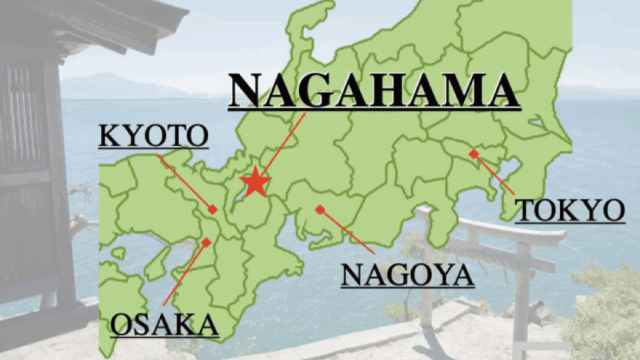
For many people, the classic Tokyo Kyoto Osaka itinerary route is the heart of their first trip. It is popular for a reason: the three cities show very different faces of Japan, and the transportation between them is straightforward once you understand the basics.
What each city brings to your trip
Tokyo is your introduction to modern Japan: neon lights, endless train lines, skyscrapers, and also quiet pockets of old neighborhoods if you know where to look. Kyoto is the cultural center with temples, gardens, wooden streets, and seasonal beauty. Osaka is the relaxed food capital, with a big sense of humor and bright nightlife, especially around Dotonbori.
Thinking of them this way helps you decide how many nights to give each city in your japan travel itinerary:
- If you love food and nightlife, Osaka gets more weight.
- If you love temples, shrines, and traditional scenes, Kyoto becomes the star.
- If you enjoy big-city energy and shopping, Tokyo will take a bigger slice.
One-way vs. round-trip routes
There are two main shapes for a Tokyo Kyoto Osaka itinerary route:
- Open-jaw: Fly into Tokyo and out of Osaka (or the other way around). This often saves a long backtrack trip at the end.
- Round-trip: Fly in and out of the same airport, usually Tokyo, and make a loop: Tokyo → Kyoto or Osaka → back to Tokyo.
If your airline options allow it, an open-jaw plan often feels smoother because you are always moving forward instead of returning to the starting point.
How long to stay in each city
As a baseline, I recommend aiming for:
- Tokyo: at least 3 nights for a first visit
- Kyoto: 3–4 nights if you enjoy culture and photography
- Osaka: 1–2 nights, or day trips from Kyoto if you are short on time
Of course, you can adjust based on flights and personal preferences, but this pattern gives you enough time to get beyond the very top tourist spots.
Point: On a Tokyo Kyoto Osaka itinerary route, try to think in “zones” rather than individual spots. Plan one or two areas per day (for example, Asakusa + Skytree area in Tokyo, or Arashiyama in Kyoto), and let yourself walk, snack, and explore instead of racing from place to place only to take quick photos.
JR Pass for a Japan travel itinerary explained
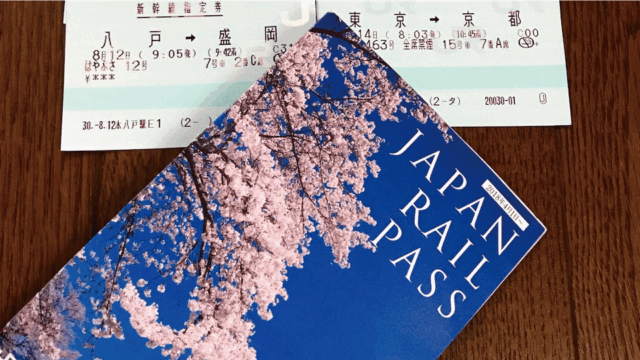
The JR Pass is something almost every visitor hears about early in their planning, and it can be confusing. For some japan travel itinerary patterns, it is very useful; for others, buying single tickets is more flexible and sometimes cheaper. So let’s break it down in a calm way.
What the JR Pass actually is
The JAPAN RAIL PASS is a special pass offered jointly by the JR Group companies and is designed mainly for foreign tourists. In simple terms, you pay a fixed price for 7, 14, or 21 days and can use many JR trains, including certain Shinkansen, during that period. For official details on types, validity, and prices, always rely on the official JR Group information (source: JAPAN RAIL PASS official site by JR Group).
When the JR Pass might make sense
For a straightforward Tokyo Kyoto Osaka japan travel itinerary, the JR Pass can be cost-effective if you are:
- Traveling multiple long-distance routes within 7–14 days (for example, Tokyo → Kyoto → Hiroshima → Osaka → Tokyo)
- Adding far regions like Hokkaido or Kyushu into your schedule
- Planning many side trips on JR lines, such as several day trips from one base city
If your plan includes only Tokyo and Kyoto with one round-trip Shinkansen ride and mainly local trains otherwise, often single tickets plus an IC card work fine. The exact calculation depends on your specific route and travel dates.
How to decide calmly
The easiest way to decide is:
- Write down all your long-distance journeys (for example, Tokyo → Kyoto → Osaka → Tokyo)
- Look up approximate prices for each journey on a major booking or timetable site
- Add them up and compare with current JR Pass prices for the relevant duration
If the sum of individual tickets is much lower than the pass, you probably do not need it. If the difference is small, you may still choose the JR Pass for the convenience and flexibility of hopping on JR trains within cities and regions.
All prices and conditions mentioned here are only general examples. JR Pass rules, eligible lines, and prices can change, and regional passes also have their own conditions. Always check the latest information on official JR websites before buying, and if you are unsure about a bigger financial decision or complex route, you may want to consult a professional travel agent. Final ticket choices are your responsibility, so treat these explanations as friendly guidance rather than strict financial advice.
If you want to go deeper into official resources, flight timings, and basic travel tools for Japan, you may find it helpful to read my official travel essentials guide for Japan, where I also collect updated JR resources and other key information in one place.
In short, for most first-time visitors sticking to the Golden Route, a JR Pass for a Japan travel itinerary is something to carefully consider, not something you should feel pressured to buy by default.
Japan travel itinerary practical guide

Now that you have a rough map and route ideas, this second part focuses on making your japan travel itinerary actually work in real life: timing, budget, internet, different travel styles like solo, couple, or family trips, and what to do when plans change. Think of this section as a toolkit you can apply to any route you choose.
Practical Guide to a Japan Travel Itinerary for real travel
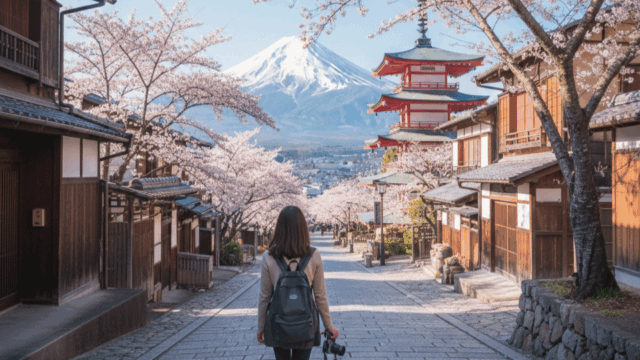
When you move from “dreaming” to “booking,” small details suddenly start to matter a lot. Where do you keep your luggage between check-out and your train? How early should you book hotels or popular attractions? How can you avoid rushing from place to place and feeling stressed about being late?
Designing your daily rhythm
A practical guide to a Japan travel itinerary starts with how your typical day looks. You do not need to plan every minute, but it helps to think in blocks. For example:
- Morning: one main area or attraction (temple district, castle, big museum)
- Lunch: somewhere nearby, ideally a local favorite rather than the closest chain inside a station
- Afternoon: one lighter activity (shopping street, market, park, neighborhood walk)
- Evening: dinner plus a relaxed stroll, maybe with one night-view spot
If you try to fit three or four “big” attractions per day in different parts of the city, transport time and mental fatigue will catch up with you fast. It is perfectly okay—and honestly better—to leave some things for your next visit. Japan will still be here.
Handling luggage and check-in/check-out
One common worry is what to do with luggage when moving between hotels. In Japan, you have a few very convenient options:
- Coin lockers at many train stations (good for small to medium suitcases)
- Luggage storage services inside stations or near major hubs
- Luggage delivery (takkyubin) from hotel to hotel, which lets you travel light for a day or two
For a smoother japan travel itinerary, consider sending your big suitcase ahead using a delivery service and traveling with just a small backpack on transfer days. This is especially nice when you have to navigate crowded stations or stairs.
Booking strategy: what to lock in and what to keep flexible
You do not need to pre-book every meal or minor attraction. Instead, focus on:
- Flights and long-distance trains with limited seats (if traveling on peak days)
- Hotels, especially during cherry blossom and autumn foliage seasons
- Popular experiences that require reservations (teamLabs, certain themed cafés, some museums, Ghibli-related spots, etc.)
Everything else can often be decided a day or two in advance. Keeping some flexibility is healthy because your energy and interests may shift once you are actually here. A practical guide to a Japan travel itinerary is not about scripting your life; it is about giving your trip a solid backbone so you can relax into the experience.
Best time to visit Japan itinerary by season
Japan changes a lot by season, so the best time to visit Japan itinerary for you really depends on what you want to experience and what you prefer to avoid. Let’s look at each season with both beauty and practical points in mind.
Spring: cherry blossoms and cool air
Spring, especially from late March to early April in many major cities, is the most famous season. Sakura trees bloom along rivers, in parks, and around castles, and locals also enjoy hanami picnics. The temperature is generally comfortable, and it feels great to walk around cities like Tokyo and Kyoto.
The trade-off is that prices and crowds are higher. Hotels book up early, trains can be busier, and popular viewpoints might be packed during peak weekends. If your dream japan travel itinerary includes cherry blossoms, it is worth facing the crowds, but be ready for flexible timing because actual bloom dates change slightly every year.
Summer: festivals, mountains, and heat
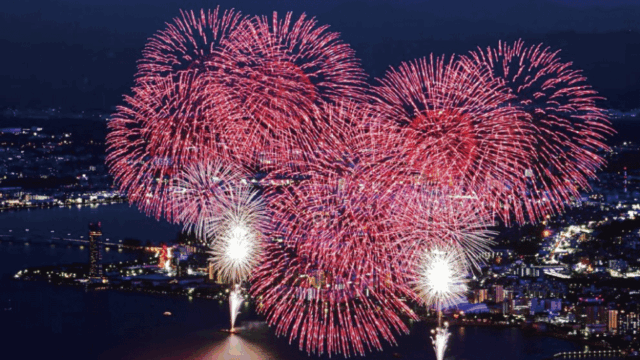
Summer in Japan is hot and humid in most cities, especially in July and August. However, this is also the season of fireworks festivals, local matsuri, and lively evening streets. If you are okay with heat and plan enough shade and drink breaks, summer can be very exciting.
For heat-sensitive travelers, including a few days in cooler regions such as higher-altitude areas or up north can make a big difference. Also, air conditioning is widely available, so plan indoor activities in the middle of the day and enjoy outdoor events in the morning or evening.
Autumn: red leaves and comfortable weather
Autumn, roughly from late October to late November in many areas, is another favorite. The colors can be stunning, especially in Kyoto’s temple gardens and mountainous regions. The air is usually crisp and pleasant, making it a very comfortable time to walk around for hours.
As with spring, popular spots get crowded at peak leaf-viewing times. If you want quieter experiences, consider visiting slightly before or after the official peak and exploring less famous temples and parks.
Winter: quiet cities and snow adventures
Winter in cities like Tokyo and Osaka can be surprisingly sunny and bright, with cool but not extreme temperatures most days. Tourist numbers are often lower outside of New Year holidays, which makes it easier to enjoy major sights without big lines.
For snow lovers, regions like Hokkaido and the Japanese Alps offer excellent skiing and winter scenery. Just make sure your japan travel itinerary includes appropriate clothing, and always check transport updates if heavy snow is expected.
Seasonal trends, weather patterns, and travel costs can vary from year to year. Any seasonal suggestions here are general impressions, not guarantees about exact bloom dates, snowfall, or price levels. For accurate forecasts and up-to-date advisories, please always consult official sources such as meteorological agencies, airlines, and government tourism sites, and consider talking with a travel professional if you are planning a complex or time-sensitive trip. Final travel decisions should always be made at your own discretion.
Budget Japan travel itinerary tips that work

Building a budget Japan travel itinerary is less about constantly saying “no” and more about deciding where you really want to say “yes.” Japan gives you many ways to experience the country without overspending, especially if you focus on smart choices in accommodation, food, and transportation.
Accommodation: location vs. room size
In Japan, hotel rooms can be smaller than what you might be used to in the US, UK, or Australia. Business hotels are a common and very practical choice: they are simple but clean, usually near stations, and often include amenities like pajamas, toiletries, and sometimes even free coffee.
If you are on a budget, staying one train stop away from the busiest station can sometimes lower costs while keeping you close to the action. For example, instead of staying right inside Shinjuku, you might choose a nearby area on the same train line with a quieter environment and slightly lower prices.
Food: eating well without expensive restaurants
One of the happiest surprises for many travelers is how well you can eat in Japan without going to high-end places. You can enjoy:
- Local ramen shops with generous bowls
- Standing sushi bars with fresh fish at reasonable prices
- Department store food floors (depachika) with beautiful bento and side dishes
- Convenience stores with surprisingly tasty onigiri, salads, and hot snacks
Reserve your splurge budget for one or two special meals, like kaiseki in Kyoto or a higher-end sushi experience, and let the rest be casual but satisfying. This balance keeps your budget Japan travel itinerary enjoyable and still full of great food memories.
Transport: passes, IC cards, and walking
For city transport, IC cards (or their mobile versions) are very convenient. You simply tap in and out of trains and buses, and the correct fare is deducted automatically. Walking is also underrated; many interesting streets and small local shops are found between major stations, not right in front of them.
For longer routes, compare the cost of JR Pass, regional passes, express buses, and individual tickets. Buses can be cheaper but usually take more time. In some cases, taking one overnight bus might save you a hotel night and still fit your schedule, but be honest about your comfort level with sleeping on buses.
Point: Any specific numbers you hear about “average daily budget in Japan” are only rough examples. Actual daily costs depend heavily on your hotel category, restaurant choices, and how much shopping you do. Treat all budget estimates as soft guidelines and confirm real prices directly with hotels, transport companies, and attractions before finalizing your japan travel itinerary.
Self-guided Japan itinerary advice from locals
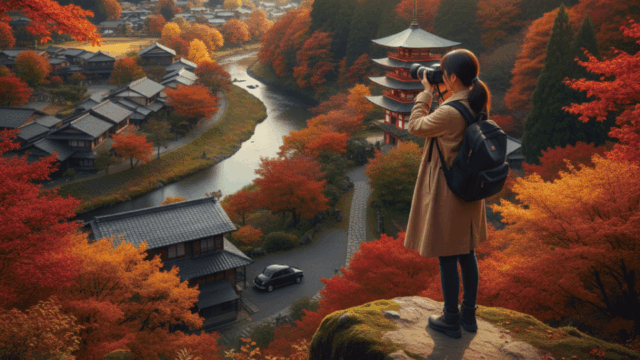
A self-guided Japan itinerary can feel intimidating at first, but once you understand a few patterns, it becomes a very comfortable way to travel. Japan’s public transportation is extensive and usually punctual, and big city stations have plenty of English signs and helpful staff.
Basic tools for self-guided travel
Here are some things that make self-guided travel much easier:
- A good map app with offline options, so you are not lost if your signal is weak
- A train route app that shows platform numbers, transfer times, and fares
- Hotel information saved in both English and Japanese, especially addresses
- A small notebook or note app with screenshots of key bookings and reservation codes
Having these ready means you are not constantly digging through email or trying to remember which line goes where. It also makes asking for help easier, because you can simply show staff the name of your hotel or the station you are looking for.
Mindset for self-guided trips
The most important mindset for a self-guided japan travel itinerary is to accept that tiny mistakes will happen and that they are okay. You might take the wrong exit from a station, or get on a local train instead of a rapid one. In most cases, the “mistake” just costs you a few minutes and maybe gives you a bonus view of a neighborhood you would never have seen otherwise.
When you feel stuck, remember that station staff, convenience store workers, and even fellow passengers are often kind and willing to help if you ask politely. A simple “Sumimasen, can you help me?” with the station name on your phone works surprisingly well.
For connectivity, many self-guided travelers feel more relaxed with a pocket Wi-Fi or eSIM, so they can check maps and translation tools anytime. If you want a deep dive into options and real usage examples, you can read my pocket WiFi Japan wireless guide, where I compare pocket Wi-Fi, SIM, and other choices from a practical angle.
One more small local tip: do not worry about “perfect” Japanese. Simple phrases like sumimasen (excuse me) and arigatou (thank you) plus a friendly tone already go a long way. Most staff in big stations, hotels, and attractions are used to English or basic gestures, so you can absolutely handle a self-guided Japan itinerary without speaking fluent Japanese.
Family Japan travel itinerary ideas that fit

If you are traveling with kids, your family Japan travel itinerary ideas need a slightly different rhythm. The key is not to chase the maximum number of landmarks, but to design a trip that feels fun and manageable for everyone, including you as the parents.
Choosing kid-friendly bases
For families, staying in two main bases during a 7–10 day trip usually works best. A typical combination is:
- Tokyo as the base for city attractions, theme parks, and easy day trips
- Kyoto or Osaka as the base for temples, castles, and street food
From Tokyo, you can consider day trips to places like Yokohama (for Cup Noodles Museum and the harbor area) or nearby theme parks if that fits your budget and interests. From Kyoto or Osaka, Nara is a very popular family spot where kids can see deer up close in Nara Park.
Balancing “wow” days and “easy” days
With children, it helps a lot to alternate heavy sightseeing days with softer days. For example:
- Day 1: Arrival and simple neighborhood walk
- Day 2: Big day—Tokyo Skytree, river cruise, and a fun district
- Day 3: Easy day—local park, small museum, relaxed lunch
This pattern keeps energy levels stable and leaves everyone in a better mood. Kids often remember small things like vending machines, local playgrounds, and train rides just as fondly as famous temples.
Food, rest, and flexibility
Japan is generally very child-friendly with food. Even picky eaters often find something they like, such as plain rice, noodles, fried chicken, or simple sushi. Convenience stores are your secret weapon for quick snacks, drinks, and emergency meals when kids are suddenly hungry.
Try to build slightly longer lunch breaks into your japan travel itinerary than you would for an adults-only trip, and do not be afraid to return to the hotel a bit earlier on some nights. A calm evening with convenience-store snacks and a Japanese TV show can become a fun memory too.
Point: When planning as a family, involve your kids in choosing at least one activity each. When they can say “this Pokémon Center is my choice” or “I picked this aquarium,” they feel more connected to the journey, and your family Japan travel itinerary becomes a shared project instead of something that adults just push onto them.
Final Japan travel itinerary summary and next steps
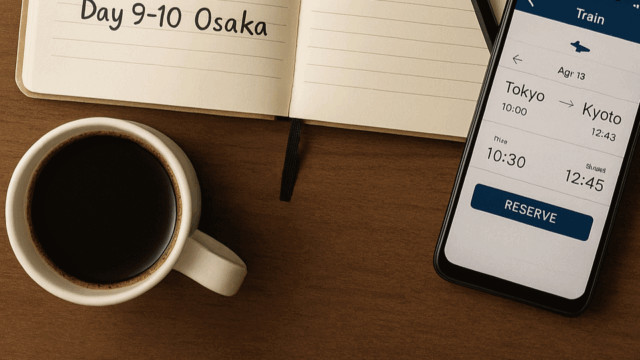
Let’s bring everything together and give you a clear path forward. A good japan travel itinerary does not need to be perfect or cover everything. It just needs to match your time, your interests, and your energy level in a way that feels honest to you.
For a 7-day trip, focusing on a simple Tokyo–Kyoto (plus maybe Nara) pattern gives you a rich taste of modern and traditional Japan without too many hotel changes. For a 10-day trip, adding a place like Hakone, the Fuji area, or Osaka makes your route feel more complete while still staying manageable.
The Tokyo Kyoto Osaka itinerary route is a great backbone because the transport links are strong and the contrast between the cities is very satisfying. On top of that, you can add seasonal experiences like cherry blossoms, autumn leaves, or winter hot springs to customize your trip.
- Use the classic Golden Route as a starting structure, not a rigid rule.
- Decide early how many nights you want in each base city.
- Check whether a JR Pass for a Japan travel itinerary actually fits your routes and dates.
- Think in daily rhythms rather than long lists of attractions.
- Leave room for rest, surprises, and small moments.
From here, your next steps are simple:
- Confirm your dates and book your international flights.
- Choose your main bases (for example, Tokyo and Kyoto, plus one extra area if you have time).
- Roughly assign nights, then plug in high-priority sights and experiences.
- Decide which bookings need to be made early (hotels, certain trains, key attractions).
All route ideas, budgets, and timing suggestions in this article are general guidelines based on common patterns. Real conditions—such as ticket prices, opening hours, weather, and health or safety recommendations—can change, sometimes quickly. For the most accurate and up-to-date details, always check official websites for transport, attractions, and government advisories before you finalize your plans. If you are unsure about any important decision, especially related to health, visas, or high travel costs, consider consulting a qualified professional. Please treat this japan travel itinerary guide as friendly support, and make your final choices at your own responsibility.
My hope is that this practical, locally grounded guide helps you feel more confident about building your own japan travel itinerary at your own pace. When you finally land in Japan and step out of the airport, I want you to feel that you already have a clear but flexible plan in your pocket—and that the trip ahead of you feels exciting, not stressful. If this article helped you sketch out your route, then we have already taken the first step of your journey together. Enjoy planning, and I truly hope our paths cross someday here in Japan.